
Compliance
Medical Waste Compliance Without the Runaround
Clear roles, practical support, and a plan your team can follow.

Clear roles
Compliance is a team effort. We help make it manageable.
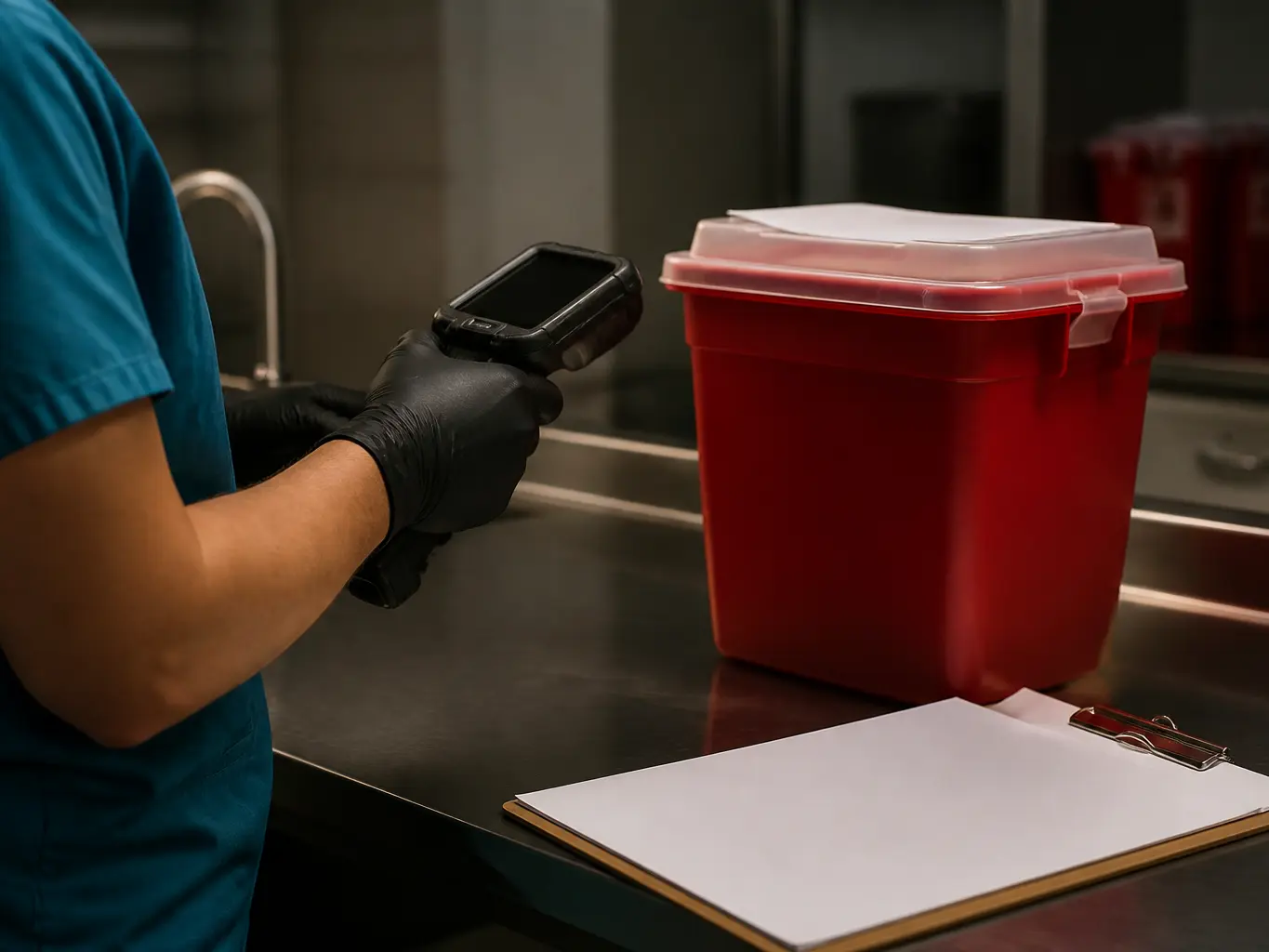
Your facility owns its program; we help you put the right containers, routines and records in place.
Last reviewed August 14, 2026
Paperwork
Your paperwork should be ready when you need it
Good records make a busy day easier. We will explain the documentation connected to your service and help your team know where to keep it.
The customer receives the legal documentation necessary for their service records, including the documentation associated with collection and destruction.

After pickup
Know what happens after pickup
You get a clear view of the journey after collection. After pickup, the waste is removed and transported to another facility for destruction. The material is then appropriately recycled or disposed of through the downstream process.
The federal rule people still quote expired in 1991
No single authority governs medical waste. Several touch a Utah facility, and each one covers a different part of the problem.
| Authority | Rule | What it covers | Who it binds |
|---|---|---|---|
| OSHA | 29 CFR 1910.1030 | The Bloodborne Pathogens Standard: exposure control planning, sharps handling, labelling, training and vaccination offers. | Employers with employees who have occupational exposure to blood or other potentially infectious material. |
| DOT | 49 CFR | Transport of regulated medical waste as a hazardous material. The proper shipping name is "Regulated medical waste, n.o.s.", UN3291, Hazard Class 6.2. | Anyone who offers the shipment for transport, and anyone who transports it. |
| DOT | 49 CFR 172.704 | Hazmat employee training, including recurrent training at least once every three years. | Employers of hazmat employees. Whether your staff count depends on whether they prepare shipments or sign shipping papers. |
| EPA | 40 CFR part 266, subpart P | Management standards for hazardous waste pharmaceuticals at healthcare facilities, including the prohibition on sewering them. | Healthcare facilities and reverse distributors. |
| EPA | RCRA, 40 CFR | Hazardous waste, including pharmaceuticals that are P-listed, U-listed or exhibit a characteristic such as ignitability, corrosivity, reactivity or toxicity. | Generators of hazardous waste, in the category their monthly quantity puts them in. |
| DEA | 21 CFR part 1317 | Disposal of controlled substances, to a destruction standard of "non-retrievable". | DEA registrants. |
| State of Utah | Utah DEQ | The governing definition of regulated medical waste in Utah, its storage time limits and its treatment standards. Utah medical waste is regulated by the Utah Department of Environmental Quality, Division of Waste Management and Radiation Control. | Every Utah facility that generates medical waste. |
| Federal, historic | MWTA 1988 | The Medical Waste Tracking Act of 1988 created a federal demonstration program. It expired in 1991 and no comprehensive federal rule replaced it, which is why the medical waste answer changes at a state line. | Nobody today. This row is here because its absence is the thing people get wrong. |
| HIPAA | Privacy Rule | Protected health information, not waste as a category. A patient name printed on a label or a package is a privacy question with its own separate answer. | Covered entities and their business associates. |
This table names the rules. It does not assert that Shred Med holds any certification or accreditation, and nothing on this page should be read that way.
Four words. Three of them get used to mean something else.
These terms help your team and your provider stay aligned about what each document means.
Generator
- The generator of medical waste is the facility that produces it, and generator status stays with that facility rather than transferring to whoever collects, transports or treats the waste.
- Counts as Generator
- The clinic, practice, lab or surgery centre where the waste is produced
- Not Generator
- The hauler who collects and transports it
- The facility that treats it afterwards
Other potentially infectious material (OPIM)
- Other potentially infectious material, usually shortened to OPIM, is OSHA's term for the materials besides blood that the Bloodborne Pathogens Standard covers.
- Also called: OPIM
- 29 CFR 1910.1030
Tracking document
- A tracking document is the paperwork that travels with a waste shipment from the generator to its destination.
- Also called: Manifest
- Not Tracking document
- A certificate of destruction, which is issued after treatment rather than travelling with the load
Certificate of destruction
- A certificate of destruction, also called a certificate of treatment, is the record issued after the waste has been treated.
- Also called: Certificate of treatment
- Not Certificate of destruction
- A tracking document, which moves with the shipment and is not evidence that treatment happened
Start here
Your team knows the rooms. We help make the routine work.
Your facility is the generator because it knows what is produced in each room. That context helps us design a service that fits how your team actually works.
We help with the practical pieces: the right containers in the right places, a clear collection routine and records your team can find when it needs them. We will explain where responsibilities meet and answer questions before they become a problem.

A clear handoff keeps everyone on the same page.
We map the handoff with you so your team knows what happens at the point of use and we know what to collect, carry and document.
| You | Shred Med | |
|---|---|---|
| Who segregates the waste at the point of use? | You, in the room where it is generated. | Your team sorts in the room; we collect the container exactly as it was sealed. |
| Who closes and seals the container? | You, at the fill line, before collection. | Containers reach the truck already closed, so nothing is handled loose on the way out. |
| Who supplies the containers and decides where they sit? | You designate the storage area and keep the containers in it. | We supply the containers and place them where they are usable. |
| Who trains your staff and writes your written plans? | You. Staff training and your own written plans and policies are yours. | Yours to own. We walk the rooms with you at setup and answer the question whenever the boundary is not obvious. |
| Who collects and transports the sealed waste? | Nothing for your team to do here. | We collect on the agreed schedule and transport the sealed waste. |
| Who hands over the documentation for a collection? | You receive it and file it. | We hand it over for each collection. |
| Who keeps the records afterwards? | You, for as long as your own requirements say. | We hand you the documentation for every collection; the file itself stays with you. |
| Who is the generator of the waste? | You. The facility that produces the waste is the generator. | We support your program, but the facility remains the generator of the waste. |
A clear handoff from your rooms to ours.
Your team handles the room-level routine; we handle collection and transport. We make the handoff clear so each step stays simple.
Segregate at the point of use
Waste goes into the right container in the room where it is generated. Segregation is the step that decides cost, because regulated medical waste costs more per pound to transport and treat than ordinary solid waste, and what ends up in the red bag is decided by hands, not by patient volume.
Close it, seal it, stage it
Containers are closed, sealed at the fill line and kept in the storage area you designated. A container that is not closed is not ready to move.
Collection and transport
Shred Med collects on the agreed schedule and transports the sealed waste. From the moment it is offered for transport the load is a DOT hazardous material, shipped as UN3291, Regulated medical waste, n.o.s., Hazard Class 6.2.
Paperwork changes hands
A tracking document travels with the shipment. A certificate of destruction or treatment is issued after treatment. They are two different documents answering two different questions, and a provider who conflates them is worth a second question.
Treatment changes what the waste legally is
Regulated medical waste is treated, most commonly by autoclaving (steam sterilisation, after which the residue is typically landfilled) or by incineration. Autoclaved, treated waste is generally no longer regulated medical waste, which is why treatment is the step that changes the waste's legal status rather than just its volume.
The file stays easy to find
Keep the records where your team can find them. We will explain which records belong with your service and help you understand where each piece fits.
The checks that keep a small practice on solid ground
These are the gaps we see most often in small facilities, and the simple habit that closes each one.
Running without a written Exposure Control Plan
OSHAOSHA's Bloodborne Pathogens Standard requires a written Exposure Control Plan, reviewed and updated at least annually.
Do this insteadWrite the plan, then put its annual review on the calendar rather than in someone's memory.
29 CFR 1910.1030Training staff once at hire and never again
OSHA29 CFR 1910.1030 requires annual bloodborne pathogens training for employees with occupational exposure, and OSHA training records must be kept for three years.
Do this insteadRun the training every year, and keep each record for three years.
29 CFR 1910.1030Skipping the hepatitis B vaccination offer
OSHA29 CFR 1910.1030 requires the hepatitis B vaccination to be offered at no cost to employees with occupational exposure, within 10 working days of initial assignment. Employee medical records are kept for the duration of employment plus 30 years.
Do this insteadMake the offer part of onboarding and keep the written record of it, including a declination.
29 CFR 1910.1030Never starting a sharps injury log
OSHA29 CFR 1910.1030 requires a sharps injury log for employers who are required to maintain OSHA injury and illness records.
Do this insteadCheck whether your practice has to keep OSHA injury and illness records. If it does, start the log now rather than after the first needlestick.
29 CFR 1910.1030Pouring leftover hazardous waste pharmaceuticals down the drain
EPAEPA's 2019 management standards for hazardous waste pharmaceuticals prohibit healthcare facilities from sewering hazardous waste pharmaceuticals.
Do this insteadRoute hazardous waste pharmaceuticals to a container, never to a sink, a toilet or a sharps bin.
40 CFR part 266, subpart PReading "small quantity generator" as one category
EPASmall quantity generator in the RCRA hazardous waste sense is a different category from a state medical waste small-generator category, and qualifying for one tells you nothing about the other.
Do this insteadWork out your RCRA hazardous waste category and your Utah medical waste category separately, and write both down.
Treating a patient name on a package as a waste question
HIPAA governs protected health information, not waste as a category, so a label carrying a patient name raises a privacy question that the waste route does not answer.
Do this insteadDecide the two routes separately: destroy the protected health information, and dispose of the waste according to what it physically is.
Support
Container placement is one practical part of compliance.
Very few compliance problems in a small facility are knowledge problems.
When we set up your service we walk the rooms with you: where sharps are actually generated, where the red-bag container should live, what your staff should do when something unusual turns up. If a new team member starts and the routine slips, call us: that is included, not an upsell.
Honesty
Straight answers and practical support
We will be clear about what we handle, provide the records for our part and flag anything that needs another specialist.
That way your team can keep the program moving with confidence, and you know who to call when a question comes up.
What each of these words means
What each of these words means
Three words decide which container a thing goes in, and what it costs to get rid of. They are used loosely everywhere and precisely by regulators.
Regulated medical waste
- Regulated medical waste is waste that has to be handled and treated separately from ordinary trash because it can carry infectious material, and the definition that governs a Utah facility is the state's rather than a federal one.
- Also called: RMW, Red-bag waste, Biohazardous waste
- Counts as Regulated medical waste
- Dressings, gauze and other items saturated with blood or other potentially infectious material
- Items caked with dried blood or other potentially infectious material that could release it when handled
- Disposable PPE that is genuinely contaminated
- Not Regulated medical waste
- Clean gloves, paper and packaging, which are ordinary solid waste
- Sharps, which need a rigid puncture-resistant container rather than a bag
- Utah Department of Environmental Quality
Sharps
- Sharps are objects that can penetrate skin, and once contaminated they belong in a container that is closable, puncture resistant and leakproof on the sides and bottom.
- Also called: Needles and blades
- Counts as Sharps
- Needles and syringes with needles attached
- Lancets and scalpel blades
- Broken contaminated glass
- Not Sharps
- A red bag, which stops nothing a needle does
- The regular trash, at any fill level
- 29 CFR 1910.1030(d)(4)(iii)(A)
Pharmaceutical waste
- Pharmaceutical waste is medication that will not be given to a patient, and which container it belongs in depends on how the drug is classified rather than on what it was for.
- Also called: Drug waste, Med waste
- Counts as Pharmaceutical waste
- Expired stock
- Partially used vials
- Discontinued or recalled medication
- Not Pharmaceutical waste
- The sink or the toilet: EPA management standards prohibit healthcare facilities from sewering hazardous waste pharmaceuticals
- The sharps container, which is for sharps
- 40 CFR part 266, subpart P
Container colors and labeling
Container colors and labeling
Most healthcare container colors are conventions rather than law. The table shows the labeling requirements that matter for your team.
| Colour | What it is used for | Convention or rule | Source |
|---|---|---|---|
| Red | Regulated medical waste and sharps | Convention. Red is near universal, and it is still not what the federal rule asks for | Industry convention |
| Fluorescent orange or orange-red | The biohazard warning label, not the container | Rule. OSHA requires the label to be fluorescent orange or orange-red carrying the biohazard legend, and red bags or red containers may be substituted for the label | 29 CFR 1910.1030(g)(1)(i) |
| Blue | Non-hazardous pharmaceutical waste | Convention | |
| Black | Pharmaceutical waste that is hazardous waste under RCRA | Convention. What makes the drug hazardous is the RCRA listing or characteristic, not the bin | 40 CFR part 261 |
| Yellow | Trace chemotherapy waste | Convention | |
| No colour at all | Paper, packaging and uncontaminated wrappers | Neither. Ordinary solid waste, and red-bagging it raises your bill with no compliance benefit |
Colour is convention. The label is the rule, and what counts as regulated medical waste is set by your state. Shred Med accepts all healthcare waste streams; the exact container and service plan are confirmed in writing before service starts.
The rules that already apply to you
The rules that already apply to you
These practices apply in your building today and remain part of your team’s routine with any provider.
- The standard behind most of what your staff already do
- 29 CFR 1910.1030
- OSHA's Bloodborne Pathogens Standard covers exposure control planning, sharps handling, labelling and training
- 29 CFR 1910.1030
- How the load is described the moment it is offered for transport
- UN3291
- Regulated medical waste, n.o.s., Hazard Class 6.2, under the DOT hazardous materials rules
- 49 CFR
- When the federal tracking program expired
- 1991
- The Medical Waste Tracking Act demonstration program ended and no comprehensive federal rule replaced it, so the definition is set state by state
- Medical Waste Tracking Act of 1988
What practices get wrong
What practices get wrong
Five habits we see in real rooms. Each one can affect safety or cost, and each has a practical correction.
Red-bagging everything, to be safe
CostRegulated medical waste costs more per pound to transport and treat than ordinary solid waste, so paper, packaging and clean wrappers in the red bag are a bill you wrote yourself.
Do this insteadSegregate at the point of use. Only genuinely contaminated items belong in the red bag.
Dropping a needle into a red bag
OSHAContaminated sharps must go into a container that is closable, puncture resistant and leakproof on the sides and bottom. A bag is none of those things.
Do this insteadPut a sharps container within arm's reach of the place the sharp is used, so the correct bin is also the easy one.
29 CFR 1910.1030(d)(4)(iii)(A)Filling a sharps container past the line
OSHASharps containers must be replaced routinely and not allowed to overfill. An overfilled container cannot be closed, and reaching into one is how a needlestick happens.
Do this insteadSwap the container at the fill line, not when it stops closing.
29 CFR 1910.1030(d)(4)(iii)(A)Pouring leftover medication down the drain
EPAEPA's management standards for hazardous waste pharmaceuticals prohibit healthcare facilities from sewering them.
Do this insteadRoute medication waste to a container, never to a sink, a toilet or a sharps bin.
40 CFR part 266, subpart PLeaving a full container open in the corridor until pickup day
OSHARegulated waste containers must be closed before removal to prevent spillage or protrusion of the contents during handling. A container that is not closed is not ready to move, whatever day the truck comes.
Do this insteadClose and seal at the fill line, then stage it in the storage area you designated.
29 CFR 1910.1030(d)(4)(iii)
What a credential actually tells you
What a credential actually tells you
Healthcare buyers receive several kinds of paperwork. Each document answers a specific question, so this guide shows what to look for.
| Ask any provider for | What it confirms | What it does not confirm | Source |
|---|---|---|---|
| Proof the transporter is authorised to haul regulated medical waste in your state | Somebody reviewed the hauler and authorised it under the state rules that govern your waste | What happens after the truck leaves, and nothing at all about your own obligations | |
| DOT hazmat training records for the people handling the shipment | Recurrent hazmat training at least once every three years for their hazmat employees | That your own staff are covered. That depends on whether they prepare shipments or sign shipping papers | 49 CFR 172.704 |
| The proper shipping description written on the paperwork | The load is offered as what it is: Regulated medical waste, n.o.s., UN3291, Hazard Class 6.2 | Anything about treatment, and anything about how well the waste was segregated before it was sealed | 49 CFR |
| A tracking document for each collection | That the shipment left your building, and where it was going | That it was treated. A tracking document travels with the load, it does not report the ending | |
| A certificate of destruction or treatment | That treatment happened, which is the step that changes what the waste legally is | What was actually inside the container. That part is yours to know | |
| Where the waste is treated, and by what method | The downstream end of the chain. The two dominant methods are autoclaving, after which the residue is typically landfilled, and incineration | That your generator status transferred, because it never does | |
| A certificate of insurance, with the dates and the limits | That coverage existed on the date printed on it, at the limits printed on it | Coverage tomorrow, or coverage for your loss | |
| Your own written Exposure Control Plan and training records | Your half of the file, which is the half an inspector asks for first | Anything about the hauler, and no provider paperwork substitutes for it | 29 CFR 1910.1030 |
These are categories of document, not credentials Shred Med holds, and nothing here should be read as a claim that we hold them. Ask us for ours by name and you will get a straight answer.
Ready for a cleaner, easier solution?
Ask us your compliance question. We will help you find the next clear step.