
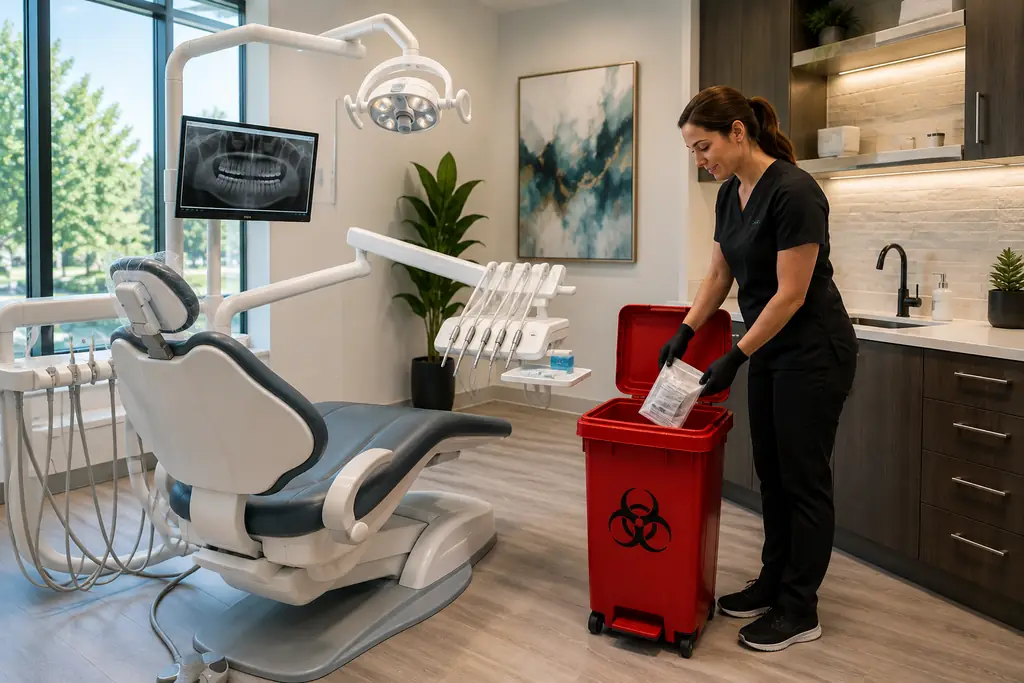
Dental practices
Dental Waste Disposal Made Easy
Sharps at every chair, a modest red-bag stream and no spare square foot in the sterilisation area. We build the program around that, not around a national template.
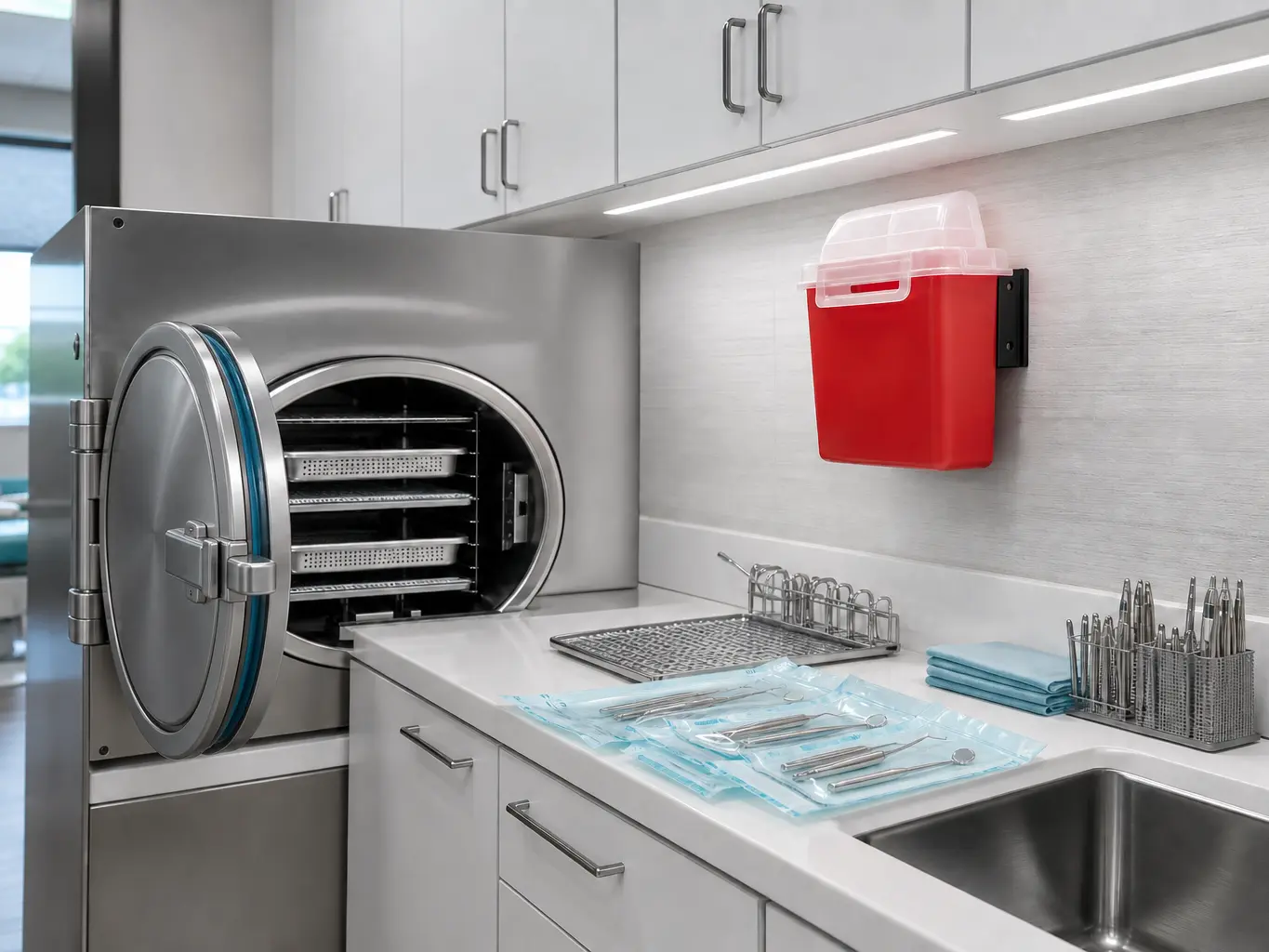
Sterilisation area
No spare square foot? We work with that.
Containers sized and placed for the room you actually have, so nothing ends up stacked where it should not be.
The sharps start at the chair, not in the sterilisation room.
Utah dental practices of any size, with service planned around each practice's rooms and volume.
- General and family practices
- Orthodontic and pediatric practices
- Oral surgery and periodontics
- Multi-location groups that want one schedule across every office
Handling & compliance details
What you generate
A dental practice is mostly a sharps problem
Needles, anesthetic carpules and blades come off the tray in every operatory, all day. Everything else is a smaller stream on top of that.
So the first decision is where sharps containers live: at the chair, within arm's reach, not down the hall. The second is how often they get exchanged. Get those two right and the rest of the program takes care of itself.
- Sharps containers placed per operatory, not per building
- A red-bag stream sized to what you actually generate
- One schedule that covers both, on one visit

Four dental streams. One of them carries mercury.
Mercury is why amalgam has a rule of its own. The other three are settled by two questions: is it contaminated, and can it puncture?
| Stream | What it is | Where it must not go | Rule | Source |
|---|---|---|---|---|
| Contaminated sharps | Needles, blades and endodontic files used at the chair | Not the red bag and not the regular trash. The container has to be closable, puncture-resistant, leakproof on the sides and bottom, and labeled or color-coded. | 29 CFR 1910.1030 | 29 CFR 1910.1030 |
| Regulated medical waste | Items contaminated with blood or other potentially infectious material | Not the regular trash. Labels are fluorescent orange or orange-red with the biohazard legend, and a red bag or red container may be substituted for the label. | 29 CFR 1910.1030 | 29 CFR 1910.1030 |
| Ordinary practice trash | Paper, packaging, uncontaminated gloves and wrappers | Not the red bag. Regulated medical waste costs more per pound to transport and treat, and red-bag volume is driven by what staff put in the bag rather than by how many patients you saw. | Not regulated | |
| Dental amalgam | Scrap amalgam, chairside trap contents, vacuum filters and separator solids | Not the red bag, not a sharps container, and not a stream that gets autoclaved or incinerated. Amalgam contains mercury. | 40 CFR part 441 | 40 CFR part 441 |
Amalgam is on this table because it is the dental stream most often put in the wrong container, not because it travels with the rest. Confirm with Shred Med which of these streams it collects before service starts.
The expensive mistakes are habits, not accidents.
Four of them, worth writing down whether or not you ever call us.
Putting scrap amalgam, chairside traps or vacuum filter contents in the red bag or a sharps container.
SafetyDental amalgam contains mercury, and mercury waste does not belong in a stream that is autoclaved or incinerated. Putting it there moves a metal problem into a heat process.
Do this insteadKeep amalgam out of the regulated medical waste stream entirely and handle it on its own path.
Assuming the amalgam separator rule is somebody else's problem.
EPAEPA's Dental Office Point Source Category rule, 40 CFR part 441, requires most dental dischargers to install and maintain an amalgam separator and to submit a one-time compliance report.
Do this insteadCheck whether your practice filed the one-time compliance report, and keep the separator maintenance records with it.
40 CFR part 441Keeping one sharps container in the sterilisation area for the whole practice.
OSHAOSHA's Bloodborne Pathogens Standard requires contaminated-sharps containers to be located as close as feasible to the immediate area where sharps are used, and carrying a used needle down a hallway is where injuries happen.
Do this insteadPut a container at every operatory that generates sharps, within reach of the tray.
29 CFR 1910.1030Red-bagging paper, packaging and uncontaminated gloves because the red bin is the closer one.
CostOrdinary practice trash is not regulated medical waste. Red-bag volume is driven by what staff put in the bag rather than by patient volume, and regulated medical waste costs more per pound to transport and treat than ordinary solid waste.
Do this insteadPut an ordinary waste bin next to every red-bag container, at the same height and the same distance.
A pickup that never touches chair time.
Three steps, and only the first one involves your team.
Containers stay where they sit
Sealed sharps containers and closed red-bag containers are left where they are. Nothing has to be moved to the front, re-packed or re-sorted. A sharps container is closed before it is removed from the area, which is what the OSHA standard requires anyway.
The technician exchanges them
Sealed containers leave sealed and clean replacements go straight back into the brackets. Nobody on your team touches a used sharp to make it happen.
Chair time is never part of it
Your front desk does not run the appointment and no operatory has to be cleared. If something has to move, you talk to a local person who can move it.
Switching
Nobody switches waste haulers for fun.
Most practices that call us are not starting from zero. They are leaving something that stopped working.
Check what notice your current agreement requires, then talk to us about timing. We will line the first pickup up so there is no gap where waste is accumulating with nowhere to go. See Why Shred Med for what changes, and Compliance for how the responsibilities split.
Ready for a cleaner, easier solution?
Tell us how many operatories you run and we will quote it straight.