
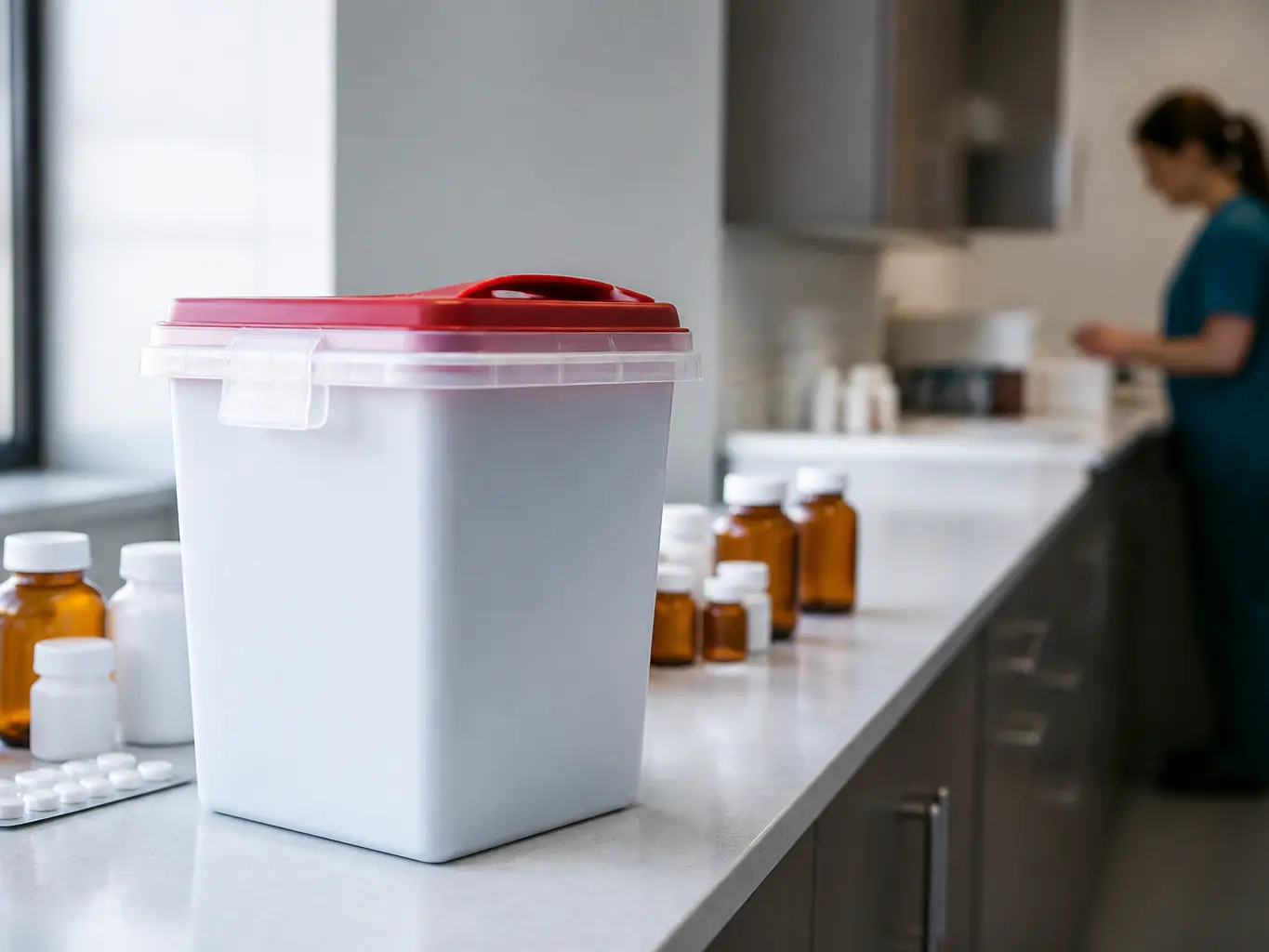
Pharmaceutical waste
Pharmaceutical Waste Solutions
Clear options for medication waste streams with the right container and disposal path.
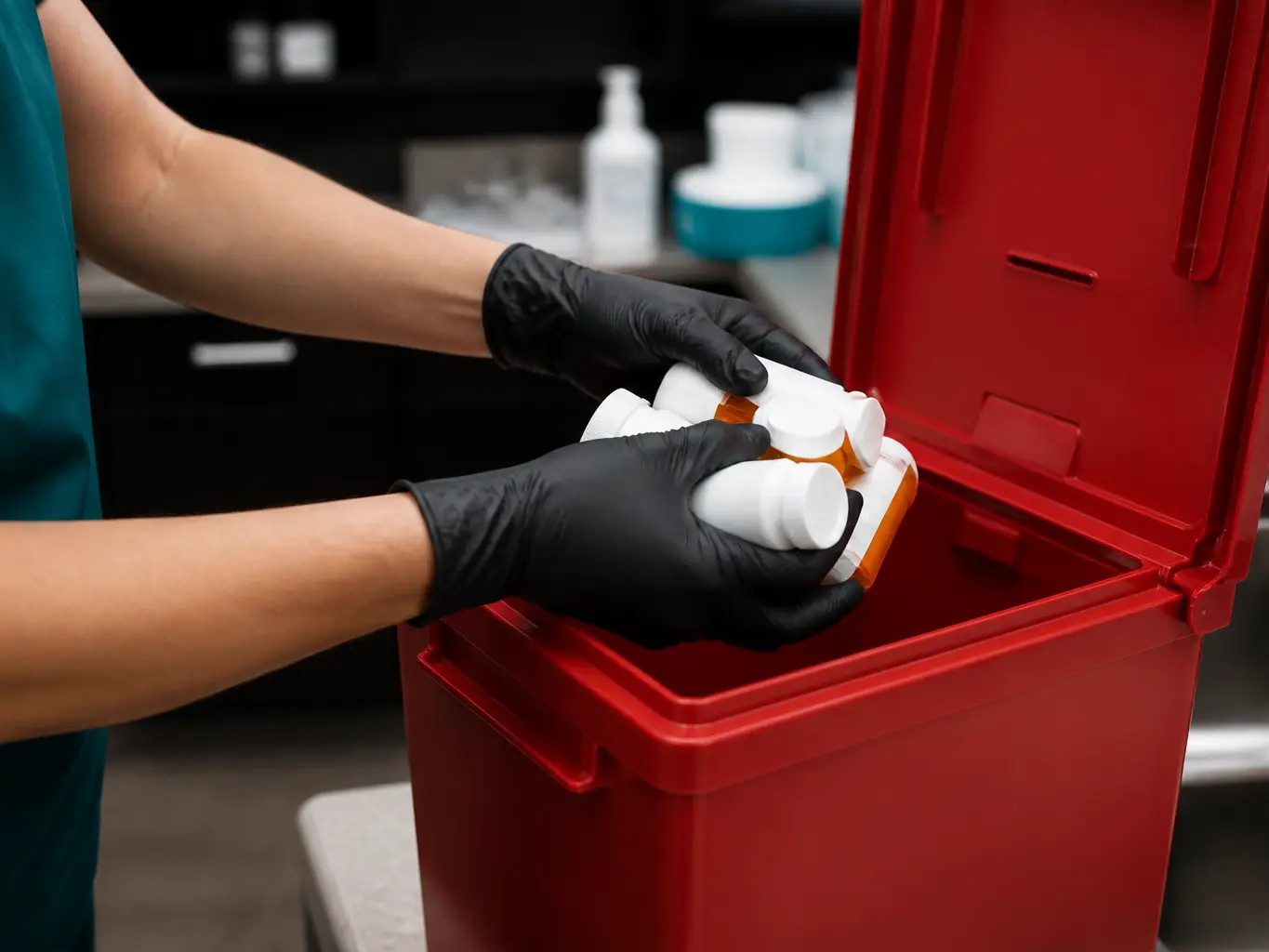
Medication waste follows its own path.
Medication waste has its own path.
It never goes in a red bag and it never goes in a sharps container. Sorting that out is the first job.
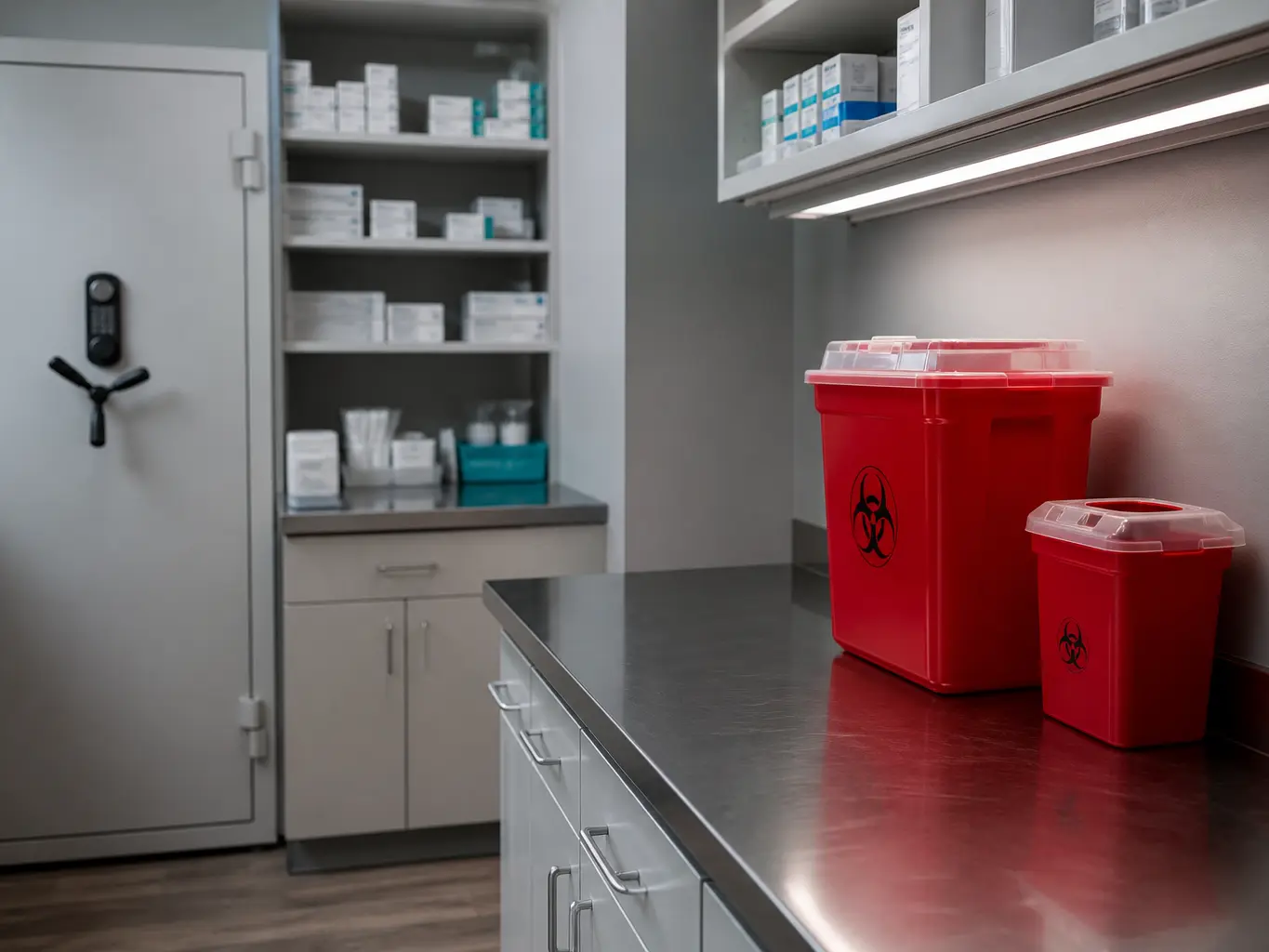
Straight answers
Send us your list. We will tell you exactly what we take.
Every stream on your list is confirmed in writing before service starts, so the first invoice holds no surprises.
What it is
Medication waste follows a separate disposal path.
Expired, unused and partially used medications have their own containers and their own disposal path. The first job is sorting out which of your streams goes where, and that answer depends on exactly what Shred Med is authorised and contracted to accept.
What we accept
You will know what we take before you sign anything.
We confirm each stream, container and handling path during setup.
Controlled substances
Controlled substances follow DEA requirements.
Controlled-substance waste is accepted as part of the all-stream program, with the required handling and documentation confirmed during setup.
Containers
Medication waste never touches a red bag.
We use standard containers and confirm the right container, handling path and sorting process during setup.
- It never goes in a sharps container either
Schedule
You should not need a second vendor for a second container.
Pharmaceutical containers are collected on the same visit as the rest of your service wherever the streams allow it.
Pickup frequency depends on the facility requirements and volume, ranging from several pickups per week to weekly service. We set the schedule around what the client needs.
Paperwork
Medication waste carries its own paper trail.
It is separate from your regulated medical waste record.
The customer receives the legal documentation necessary for their service records, including the documentation associated with collection and destruction.

Some streams need a different specialist. We will tell you which.
Most facilities run more than one medication stream, and most have at least one that has been going the wrong way for years. Send us the list and we will tell you exactly what we take and how each one is handled.
We collect the streams we are authorised to collect, and we name every one of them in writing before service starts.
Handling & compliance details
Medication waste is four different problems wearing one name.
Four categories, four different rules. Most practices generate at least two of them.
Hazardous waste pharmaceutical
- A hazardous waste pharmaceutical is a discarded drug that the Resource Conservation and Recovery Act regulates as hazardous waste, either because the drug appears on a federal list or because it exhibits a characteristic: ignitability, corrosivity, reactivity or toxicity.
- Also called: RCRA hazardous pharmaceutical waste
- Counts as Hazardous waste pharmaceutical
- A discarded drug on the RCRA P-list, for example nicotine, which is listed as P075
- A discarded drug on the RCRA U-list
- A discarded drug that is ignitable, corrosive, reactive or toxic by the RCRA characteristic tests
- Not Hazardous waste pharmaceutical
- A discarded drug that is neither listed nor characteristic, which is non-hazardous pharmaceutical waste
- A DEA controlled substance, which has a separate destruction path
- 40 CFR part 261
Non-hazardous pharmaceutical waste
- Non-hazardous pharmaceutical waste is discarded medication that is neither listed nor characteristic under the Resource Conservation and Recovery Act and is not a DEA controlled substance.
- Also called: Non-RCRA pharmaceutical waste
- Not Non-hazardous pharmaceutical waste
- Anything on the RCRA P-list or U-list
- Anything ignitable, corrosive, reactive or toxic by the RCRA characteristic tests
- Any controlled substance
Controlled substance
- A controlled substance is a drug scheduled under the Controlled Substances Act, and DEA rules require its destruction to render the substance non-retrievable.
- Also called: Scheduled drug
- Not Controlled substance
- A drug that is not scheduled, which does not need a DEA destruction path
- 21 CFR part 1317
Trace chemotherapy waste
- Trace chemotherapy waste is the term used for materials that held a chemotherapy drug and are empty, such as tubing, gowns, gloves and empty vials, as distinct from bulk chemotherapy waste, which still contains unused drug.
- Not Trace chemotherapy waste
- Bulk or unused chemotherapy drug
- A partially full vial or syringe of a chemotherapy drug
The container is the easy part. The classification is not.
Get it wrong and the waste ends up somewhere it legally cannot be.
| RCRA hazardous | Non-hazardous | DEA controlled | Trace chemo | |
|---|---|---|---|---|
| Which rule governs it? | RCRA, 40 CFR part 261, plus 40 CFR part 266 subpart P for healthcare facilities | No federal hazardous waste rule. State and local rules apply | The Controlled Substances Act and 21 CFR part 1317 | State and local rules, plus RCRA if the drug it held is listed or characteristic |
| Can it go down the drain? | No. EPA prohibits healthcare facilities from sewering hazardous waste pharmaceuticals | Subpart P does not reach it, but your state and your sewer authority may | Destruction must render the substance non-retrievable under 21 CFR part 1317 | Your state and your sewer authority decide |
| Who may accept it? | A permitted hazardous waste facility, via a hazardous waste transporter | A medical or pharmaceutical waste provider, under state rules | A DEA registrant authorised to receive it, or a reverse distributor | A medical waste provider, under state rules |
| What container does it belong in? | A container marked for RCRA hazardous pharmaceutical waste, black by convention | A pharmaceutical waste container, blue by convention | Held under your own DEA security requirements until destruction | A trace chemotherapy container, yellow by convention |
| Does it ever go in a red bag or a sharps container? | No. Red-bag waste and hazardous waste have different treatment paths | No. Medication waste is not regulated medical waste | No. A red bag is not a DEA destruction path | No. Trace chemotherapy waste is kept apart from red-bag waste |
Container colours above are industry convention, not federal law. Which of these four streams Shred Med is authorised and contracted to accept is confirmed in writing before service starts, and it is not implied by this table.
The federal rules are shorter than the folklore around them.
You do not have to take our word for any of it.
| Question | Answer | Rule |
|---|---|---|
| Which rule makes a discarded drug hazardous waste? | RCRA, when the drug is listed on the P-list or U-list, or exhibits ignitability, corrosivity, reactivity or toxicity | 40 CFR part 261 |
| What is a very small quantity generator? | A facility generating 100 kg or less of hazardous waste in a calendar month | 40 CFR 262.14 |
| What is a small quantity generator? | A facility generating more than 100 kg and less than 1,000 kg of hazardous waste in a calendar month | 40 CFR 262.16 |
| What is a large quantity generator? | A facility generating 1,000 kg or more of hazardous waste in a calendar month | 40 CFR 262.17 |
| Can hazardous waste pharmaceuticals be poured down the drain? | No. The 2019 management standards prohibit healthcare facilities from sewering hazardous waste pharmaceuticals | 40 CFR part 266, subpart P |
| Is nicotine a listed hazardous waste? | Yes. Nicotine is P-listed as P075 | 40 CFR 261.33 |
| Are over-the-counter nicotine patches, gum and lozenges P075? | No. Subpart P removed FDA-approved over-the-counter nicotine replacement therapies from the P075 listing | 40 CFR part 266, subpart P |
| How must a controlled substance be destroyed? | To a non-retrievable standard, meaning the substance cannot be transformed back into a usable form | 21 CFR part 1317 |
| What record does a DEA registrant keep for on-site destruction? | DEA Form 41 is the registrant destruction record, and on-site destruction is witnessed by two employees | 21 CFR part 1317 |
The two DEA rows apply to DEA registrants. Whether your practice is a registrant, and what that obliges you to do, is a question for your own DEA registration rather than for this page. Nothing in this table states which of these streams Shred Med accepts.
The practices that get this wrong are not the sloppy ones.
Every one of these starts as a reasonable assumption.
Pouring unused medication down the sink
EPAThe 2019 EPA management standards for hazardous waste pharmaceuticals prohibit healthcare facilities from sewering hazardous waste pharmaceuticals, and a sink is not a disposal method for anything on this page.
Do this insteadRoute every discarded medication to a container, and treat the sink as closed to medication waste.
40 CFR part 266, subpart PAssuming one "small quantity generator" means the other
EPAThe RCRA hazardous waste generator category is set by the kilograms of hazardous waste generated in a calendar month, and a state medical waste small-generator category is a different rule with a different threshold. Practices routinely read one status as the other.
Do this insteadWork out your RCRA category from your monthly hazardous waste quantity, and your medical waste category from your state rule, as two separate answers.
40 CFR 262.14, 262.16, 262.17Deciding a drug is non-hazardous because it sounds harmless
EPAWhether a specific product is P-listed, U-listed or characteristic is a determination about that product, not about how dangerous it seems, and some very ordinary items are listed.
Do this insteadHave your own formulary reviewed against the RCRA lists and characteristics by somebody qualified to do it, rather than relying on a generic list from a vendor.
40 CFR part 261Dropping a controlled substance into the pharmaceutical waste container
DEADEA rules give controlled substances a separate destruction path that has to render the substance non-retrievable, and a general pharmaceutical waste container is not that path.
Do this insteadKeep controlled substances under your own DEA requirements and confirm the destruction route in writing before anything is discarded.
21 CFR part 1317
Ready for a cleaner, easier solution?
Send us your medication waste list and we will confirm your containers, your schedule and your price.