

Surgery centers
Surgery center medical waste. Built for the heaviest case day.
Higher volume, tighter turnaround, and no tolerance for a missed pickup. That is the whole brief.
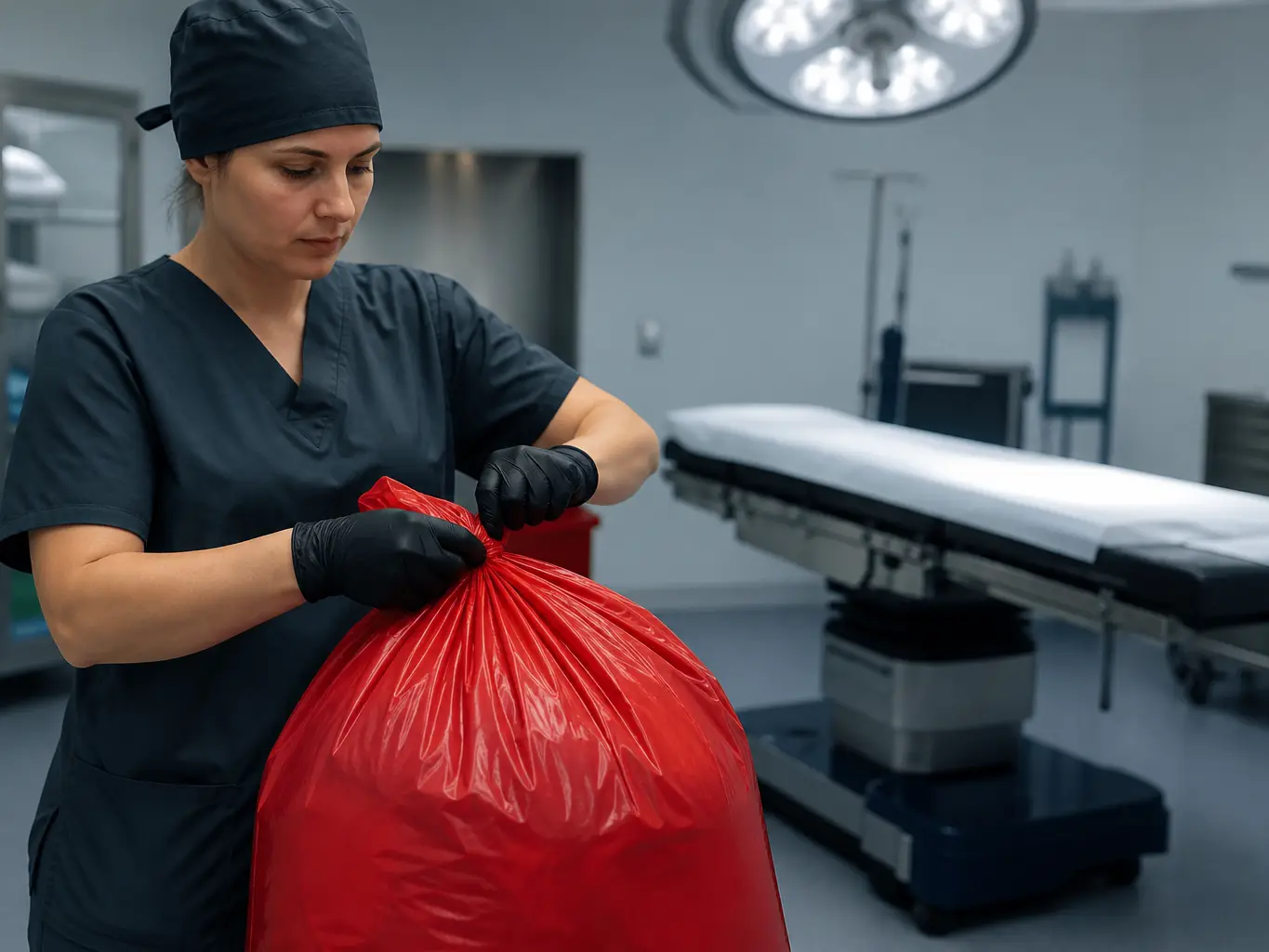
Between cases
Volume arrives in blocks. The plan is built for that.
Capacity sized to your heaviest case day, and a soiled route that stays short and one-directional.
The next case list does not wait for the waste room.
Utah ambulatory surgery centers and procedure suites where the waste room has to be clear before the next case list.
- Ambulatory surgery centers
- Endoscopy and procedure suites
- Ophthalmic and orthopedic surgical centers
- Hospital-affiliated outpatient facilities
Handling & compliance details
Case volume moves. These do not.
Two of them are about your staff. One is about the truck.
- How the load is described once it leaves your dock
- UN3291
- Regulated medical waste, n.o.s., Hazard Class 6.2
- 49 CFR
- Bloodborne pathogens training for staff with occupational exposure
- Annually
- Required by OSHA for every employee with occupational exposure
- 29 CFR 1910.1030
- Window to offer hepatitis B vaccination after initial assignment
- 10 working days
- Offered at no cost to the employee
- 29 CFR 1910.1030
Two questions decide the container. The rest is consequence.
Is it contaminated, and can it puncture. Answer those in the room and nothing has to be re-sorted later.
| Regulated medical waste | Sharps container | Ordinary solid waste | |
|---|---|---|---|
| Is it contaminated with blood or other potentially infectious material? | Yes. That is what makes it regulated. | Yes, and it can also puncture or cut. | No. Ordinary trash is not regulated medical waste. |
| Can it puncture or cut? | No. Anything that can puncture goes in a sharps container. | Yes. | No. |
| Must the container be closable, puncture-resistant and leakproof on the sides and bottom? | OSHA sets that specification for contaminated-sharps containers. | Yes, all four, under 29 CFR 1910.1030. | No. |
| Does the OSHA labelling rule apply? | Yes. Fluorescent orange or orange-red with the biohazard legend, or a red bag or red container in place of a label. | Yes. Labeled or color-coded, same rule. | No. |
| Does putting it here cost more than the correct alternative? | Yes. Regulated medical waste costs more per pound to transport and treat than ordinary solid waste. | Yes, for the same reason. | No. This is the cheapest answer, on the days it is the correct one. |
Every row is a general rule, not a determination about a specific item in your suite. The labelling and container requirements come from OSHA, 29 CFR 1910.1030.
Five requirements from one OSHA standard. The sixth belongs to the truck.
The soiled hold is where a turnover plan succeeds or fails, and none of this is a preference.
| Requirement | What it means in the room | Rule | Source |
|---|---|---|---|
| Closable | The container can be closed, and it is closed before it is removed from the area | 29 CFR 1910.1030 | 29 CFR 1910.1030 |
| Puncture-resistant | The walls resist penetration by the sharps inside | 29 CFR 1910.1030 | 29 CFR 1910.1030 |
| Leakproof on sides and bottom | Liquid cannot escape the container in normal handling | 29 CFR 1910.1030 | 29 CFR 1910.1030 |
| Labeled or color-coded | Fluorescent orange or orange-red with the biohazard legend, or a red bag or red container in place of the label | 29 CFR 1910.1030 | 29 CFR 1910.1030 |
| Replaced before it overfills | Containers are replaced routinely and are never allowed to overfill | 29 CFR 1910.1030 | 29 CFR 1910.1030 |
| Named for transport | Regulated medical waste, n.o.s., UN3291, Hazard Class 6.2 | 49 CFR | 49 CFR |
Colour convention is worth knowing: red for regulated medical waste and sharps is industry convention, not federal law. What the federal rule requires is the label or the color-coding in the row above.
Regulated containers stay their standard red.
Shred Med does not recolour a compliant container to match a brand. The red container in your soiled hold is red because a red bag or red container may be substituted for the biohazard label, and a container that is harder to read at speed is a container that gets sorted wrong during a turnover.
- Fluorescent orange or orange-red with the biohazard legend is the labelled option
- A red bag or a red container may be substituted for that label
- Every colour convention beyond those two is industry practice, not federal law
Labelling requirements above come from OSHA, 29 CFR 1910.1030.
Nothing about collection touches your case list.
Three steps, none of which happen inside a room that has a case in it.
Containers stage on the route you already use
Placement follows the route your facility already uses for soiled transport, so nothing has to cross a clean corridor to reach the dock. Sharps stay at the point of use and are never carried loose.
Sealed containers leave sealed
Nothing is opened, decanted or re-sorted on your site. Replacements are staged before the technician goes, so the next case list does not start with an empty bracket.
Capacity is checked against your heaviest day
The plan is sized for the busiest case day and the storage footprint you actually have, not for an average week that never happens. If your case volume changes seasonally, you talk to a local person who can change the schedule.
Ready for a cleaner, easier solution?
Tell us your case volume and storage constraints and we will build the plan around them.