
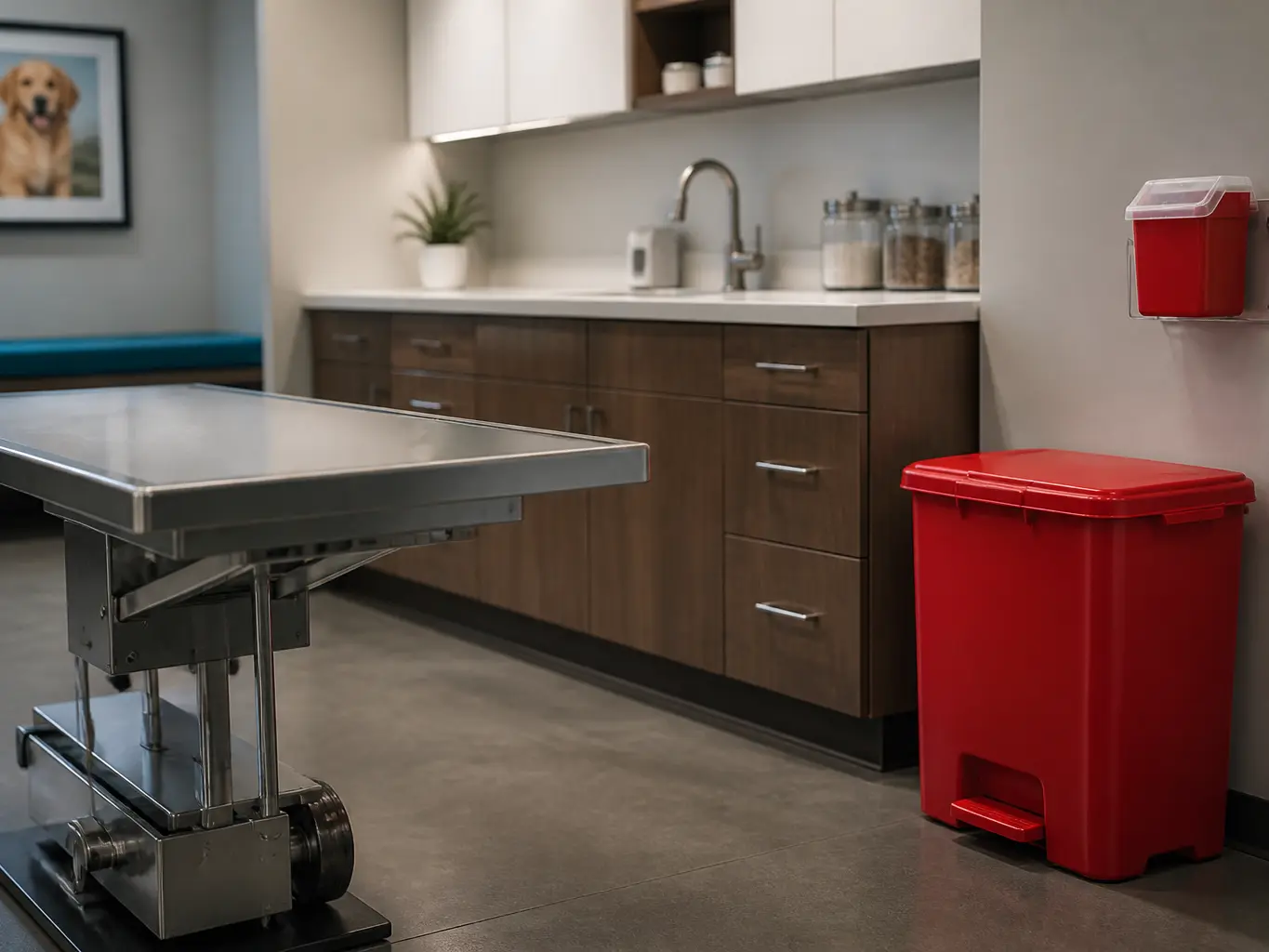
Veterinary clinics
Veterinary medical waste. Sized for surgery days.
Surgery days, sharps and a waste mix most providers never bother to ask about. We ask first, then quote.
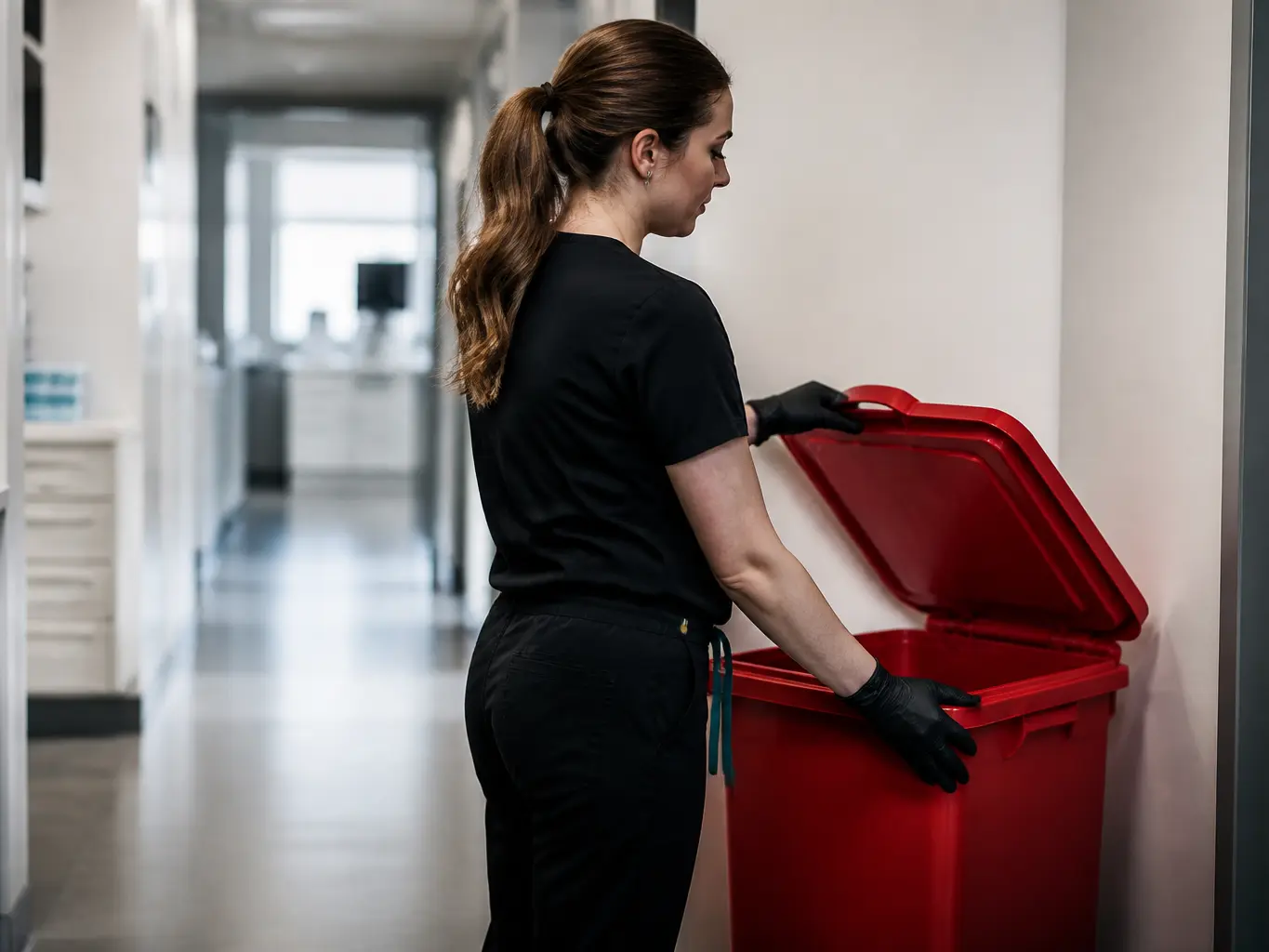
Your waste mix
We ask what you generate. Then we answer straight.
Every stream you generate is confirmed in writing before service starts, so your first invoice holds no surprises.
Exam room, surgical suite, mobile kit: sharps in all three.
Utah veterinary practices, from single-doctor clinics to multi-vet hospitals.
- Small animal and companion clinics
- Veterinary hospitals with a surgical suite
- Mobile and house-call practices with a fixed base
- Specialty and emergency practices
Handling & compliance details
The federal program expired in 1991. Your answer comes from Utah.
Three terms decide the answer, and only one of them has a single federal definition behind it.
Regulated medical waste
- Regulated medical waste is waste contaminated with blood or other potentially infectious material, and the exact boundary of the category is set by the state rather than by one comprehensive federal rule.
- Also called: Red-bag waste, Biohazardous waste, Infectious waste, RMW
- Counts as Regulated medical waste
- Items contaminated with blood or other potentially infectious material
- Contaminated sharps used on a patient
- Not Regulated medical waste
- Paper, packaging and uncontaminated gloves and wrappers, which are ordinary solid waste
- Waste that has already been treated, which is generally no longer regulated medical waste
- OSHA, 29 CFR 1910.1030
Animal-origin waste
- Animal-origin waste from a veterinary practice is categorised by state medical waste rules, because the federal Medical Waste Tracking Act of 1988 created only a demonstration program and that program expired in 1991.
- Also called: Animal pathological waste, Animal tissue waste
- Not Animal-origin waste
- Paper, packaging and uncontaminated gloves and wrappers, which are ordinary solid waste
- Medical Waste Tracking Act of 1988
Contaminated sharps
- Contaminated sharps are objects that can penetrate skin and are contaminated with blood or other potentially infectious material, and OSHA sets how their containers are built and where those containers sit.
- Also called: Sharps
- Counts as Contaminated sharps
- Needles and syringes used on a patient
- Scalpel blades and suture needles
- Contaminated broken glass
- Not Contaminated sharps
- Regulated medical waste that cannot puncture or cut, which belongs in the regulated waste container instead
- Ordinary trash, which belongs in neither
- 29 CFR 1910.1030
Four of these need an answer before the first pickup. One does not.
Your mix is lumpy, and the lumpy weeks are the ones the container plan has to survive.
| Stream | When it peaks | What has to be settled first | Source |
|---|---|---|---|
| Contaminated sharps | Every day: injection, sampling and surgery | Container placement, which OSHA puts as close as feasible to the immediate area where sharps are used | 29 CFR 1910.1030 |
| Regulated medical waste | Surgical days | Capacity sized against your heaviest week rather than an average one | |
| Animal-origin waste | Surgical days and end-of-life appointments | Which state category it falls into, and whether Shred Med collects it, confirmed in writing | |
| Medication waste | Expiry cycles and single-use overfill | Which category the drug falls into, and whether it is collected at all, confirmed before service starts | |
| Ordinary clinic trash | Constant | Nothing, provided it stays out of the regulated container |
Shred Med confirms in writing which of these streams it collects, and names the ones it does not, before service starts.
Every one of these starts with an assumption nobody checked.
Four of them cost money or create risk, and none of them needs a hauler to fix.
Waiting for a federal rule to say what your animal-origin waste is.
StateThe federal Medical Waste Tracking Act of 1988 created a demonstration program that expired in 1991, and no comprehensive federal EPA medical waste rule replaced it. States regulate medical waste, which for a Utah facility means the Utah Department of Environmental Quality, Division of Waste Management and Radiation Control.
Do this insteadAsk which state category your clinic is being placed in, and get the answer before the first pickup.
Utah DEQ, Division of Waste Management and Radiation ControlKeeping the sharps container on the treatment room counter and nowhere else.
OSHAOSHA's Bloodborne Pathogens Standard requires contaminated-sharps containers to be located as close as feasible to the immediate area where sharps are used, and a veterinary practice uses sharps in the exam room, the surgical suite and the mobile kit.
Do this insteadPut a container everywhere sharps are actually used, not only where the supply cabinet is.
29 CFR 1910.1030Letting a sharps container fill past the line because the next collection is close.
OSHAOSHA requires contaminated-sharps containers to be replaced routinely, to not be allowed to overfill, and to be closed before removal from the area.
Do this insteadClose and replace the container at the fill line, not when the lid stops shutting.
29 CFR 1910.1030Adding a stream to the pickup without telling anyone.
StateThe generator of the waste remains the generator, and that status does not transfer to a hauler. An unconfirmed stream on the truck is still your clinic's responsibility.
Do this insteadSend the full list of what your clinic produces and get written confirmation of what is collected before anything new goes in a container.
Each stream is reviewed before pricing.
The stream list comes before the container list. That order is the whole difference.
You send the stream list
Write down everything your clinic produces in a normal week and everything it produces on a surgery day. Sharps, regulated medical waste, medication waste, animal-origin waste, and anything you are not sure about.
Shred Med answers stream by stream
You get written confirmation of what Shred Med collects and a straight name for what it does not, before anybody talks about containers or price.
The plan follows the heavy week
Capacity is set against your busiest surgical day rather than an average that never actually happens, and placement follows where sharps are genuinely used.
Straight answers
Name every stream before anyone signs anything.
Every stream is named and priced up front, not figured out after the first pickup.
Send us the list of what your practice generates and we will confirm your containers, your schedule and your price in writing before service starts. See Compliance for how the responsibilities split and Sharps disposal for the container requirements in full.

Ready for a cleaner, easier solution?
Tell us what your clinic generates and we will size the containers and the schedule around it.