
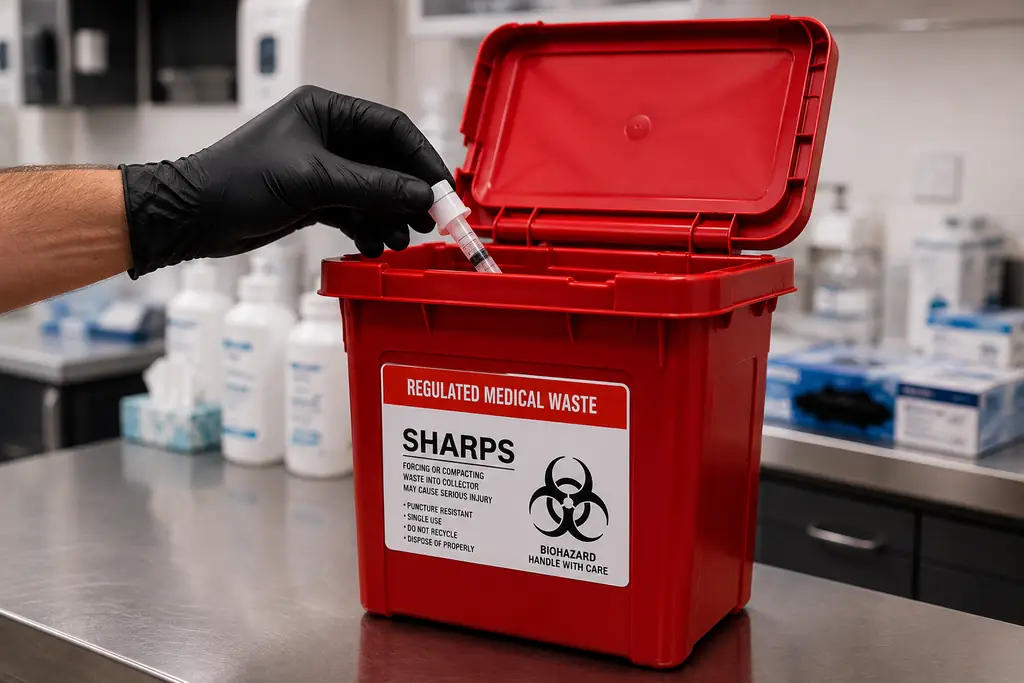
Sharps
Sharps Disposal and Container Exchange
A practical sharps program for clinics, dental practices, veterinary offices and other small generators.
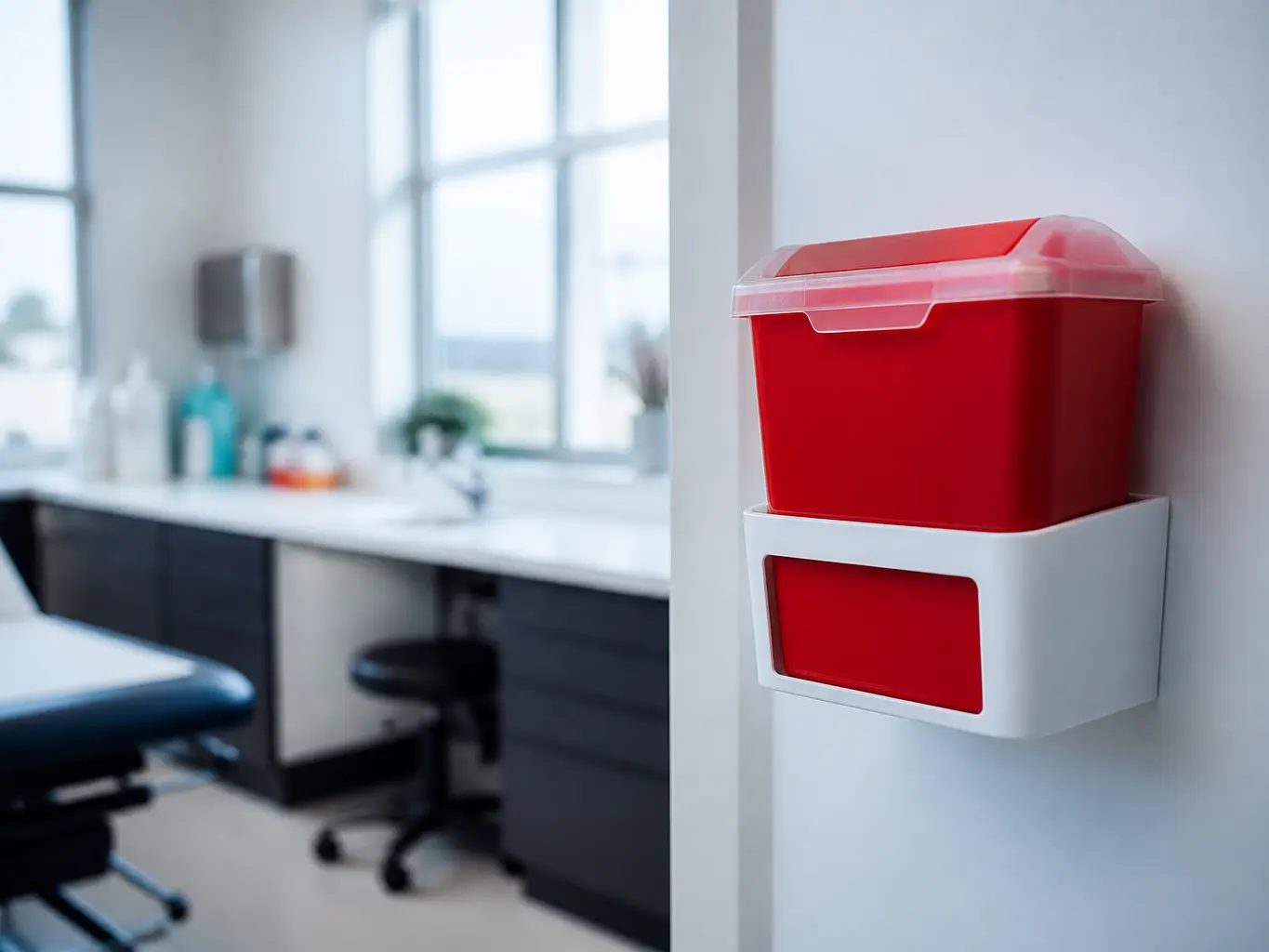
Placement
Within arm's reach. Not down the hall.
The container belongs where the sharp is actually generated: at the chair, in the exam room, on the cart.
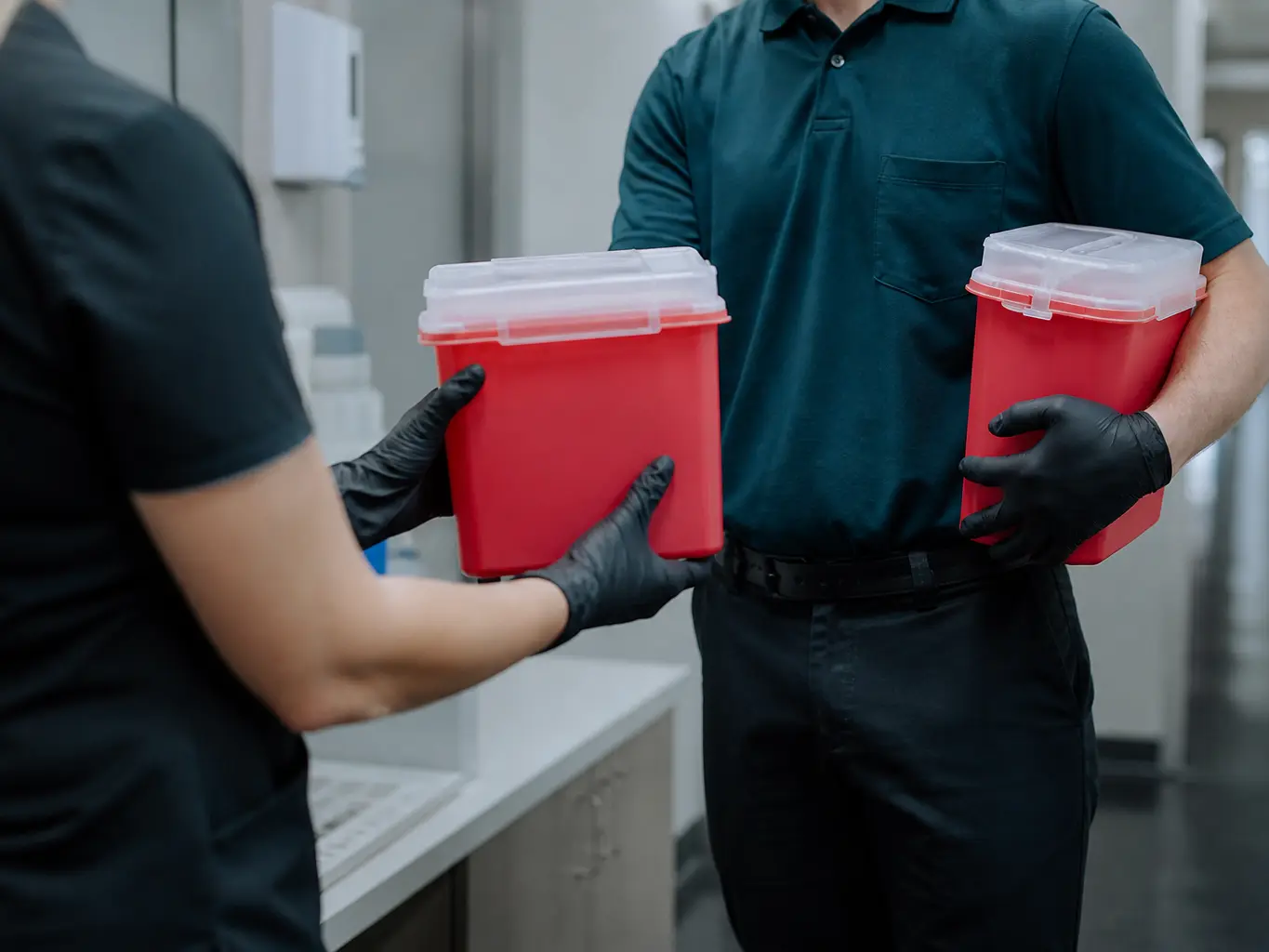
The exchange
You seal it. We take it.
A sealed sharps container leaves sealed. Nothing is decanted, tipped out or re-sorted on your site.
What it is
A clear exchange keeps the service moving.
Sharps are the one waste stream where a mistake ends up in somebody's hand. So we keep the process boring: the right container within arm's reach of where sharps are used, and a scheduled exchange before it ever gets close to full.
Containers
Size follows placement, not the other way round.
The right size is the one that fits where the sharp is actually generated (at the chair, in the exam room, on the cart) and that fills up on roughly the same rhythm as your pickups.
We use standard sharps containers in the size that fits the point of use and fills on the same rhythm as your pickups.
- Point-of-use placement beats a single large container down the hall
- Never overfill. Seal at the fill line, not above it
Schedule
One planned visit for each collection.
Exchanges run on the same schedule as the rest of your service.
Pickup frequency depends on the facility requirements and volume, ranging from several pickups per week to weekly service. We set the schedule around what the client needs.
Count places, not rooms.
The number of containers you need is the number of places a sharp is actually generated. We confirm that with you before anything is delivered.
Sharps containers stay their standard red. We do not recolour compliant containers to match our brand.
Handling & compliance details
Broken glass is a sharp. So is the end of a dental wire.
The definition is broader than needles, and the placement rule is stricter than most practices assume.
Contaminated sharps
- Contaminated sharps are contaminated objects that can penetrate the skin, which OSHA lists as including needles, scalpels, broken glass, broken capillary tubes and exposed ends of dental wires.
- Also called: Sharps waste, Sharps
- Counts as Contaminated sharps
- Needles and syringes with the needle still attached
- Lancets and scalpel blades
- Broken glass and broken capillary tubes
- Exposed ends of dental wires
- Not Contaminated sharps
- Saturated dressings and gauze, which go in the red bag
- Expired or unused medication, which goes in a pharmaceutical waste container
- Uncontaminated packaging from a sterile instrument, which is ordinary trash
- 29 CFR 1910.1030(b)
Sharps container
- A sharps container is the container OSHA requires for contaminated sharps: closable, puncture resistant, leakproof on the sides and bottom, and labeled or colour-coded.
- Counts as Sharps container
- A rigid container that closes and latches
- A container that stays upright in a bracket or holder throughout use
- Not Sharps container
- A red bag, which is not puncture resistant
- A cardboard box that is not leakproof on the sides and bottom
- Any container that cannot be closed before it is moved
- 29 CFR 1910.1030(d)(4)(iii)(A)
Point of use
- Point of use is the place where a sharp is actually generated, and OSHA requires the sharps container to be easily accessible and as close as is feasible to it.
- Counts as Point of use
- At the dental chair
- In the exam or treatment room
- On the procedure cart
- Not Point of use
- One large container in a utility room down the corridor
- A shared container at a station two rooms away
- 29 CFR 1910.1030(d)(4)(iii)(A)
How it works
A sealed container is never opened on your site.
You seal it, we take it, you get a replacement in the same visit.
Nothing is decanted, tipped out or re-sorted. Your staff never handles loose sharps, and there is no window where a full container sits waiting in a hallway.
Red-bag waste goes to your regulated medical waste container instead, covered on Regulated Medical Waste. Medication waste has its own container and its own path, covered on Pharmaceutical Waste.
- Seal the full container at the fill line
- The technician collects it on the scheduled visit
- A clean replacement goes back in the bracket before we leave

The fill line is the stop. Not the brim.
Four steps your team performs. None of them need a tool.
Stop at the fill line
OSHA requires sharps containers to be replaced routinely and never allowed to overfill, so the fill line is the stop, not the brim.
Close the lid until it latches
OSHA requires the container to be closed immediately before it is removed or replaced, so that nothing spills or protrudes during handling.
Never open it again
A sealed container is not opened, emptied, decanted or reached into. Most needlesticks after correct disposal happen at this step.
Put the replacement in the bracket
A sealed container should not leave an empty bracket at the point of use, because the next sharp still needs somewhere to go.
A sharps container is not a design choice. It is a specification.
None of this is our opinion. It is the Bloodborne Pathogens Standard.
| Requirement | What it means in the room | Citation |
|---|---|---|
| Closable | The container has a lid that closes, and it is closed before the container leaves the area where it was used | 29 CFR 1910.1030(d)(4)(iii)(A) |
| Puncture resistant | The wall of the container resists the sharps it is holding | 29 CFR 1910.1030(d)(4)(iii)(A) |
| Leakproof on sides and bottom | Liquid that goes into the container stays in the container | 29 CFR 1910.1030(d)(4)(iii)(A) |
| Labeled or colour-coded | The container carries the biohazard warning label, or is a red container in its place | 29 CFR 1910.1030(g)(1)(i) |
| Easily accessible, as close as feasible to where sharps are used | The container belongs at the chair or in the treatment room, not down a corridor | 29 CFR 1910.1030(d)(4)(iii)(A) |
| Maintained upright throughout use | The container stands in a bracket or holder rather than lying on a counter | 29 CFR 1910.1030(d)(4)(iii)(A) |
| Replaced routinely, never allowed to overfill | The container is exchanged on a schedule, and the fill line is the stop | 29 CFR 1910.1030(d)(4)(iii)(A) |
| Closed before removal from the area of use | The lid is latched before anyone carries the container anywhere | 29 CFR 1910.1030(d)(4)(iii)(A) |
The warning label OSHA requires is fluorescent orange or orange-red and carries the biohazard legend. Red bags or red containers may be substituted for the label.
The container is rarely the problem. The habit is.
Every one of these happens in practices that believe their program is fine.
One big container in the utility room instead of one at each chair
OSHAOSHA requires sharps containers to be easily accessible and located as close as is feasible to the immediate area where sharps are used, and a container down the hall means a used sharp travels the building in somebody's hand.
Do this insteadPut a container everywhere a sharp is actually generated, and count places rather than rooms.
29 CFR 1910.1030(d)(4)(iii)(A)Pressing the contents down to fit one more sharp in
SafetyOSHA requires sharps containers to be replaced routinely and not allowed to overfill, and a hand going into a full container is how a needlestick happens after the sharp was already disposed of correctly.
Do this insteadClose the container at the fill line and start a clean one.
29 CFR 1910.1030(d)(4)(iii)(A)Recapping the needle before disposing of it
OSHAOSHA prohibits bending, recapping and removing contaminated needles except where there is no feasible alternative or the procedure requires it, and the recapping motion is itself a common injury mechanism.
Do this insteadDiscard the needle into the sharps container at the point of use, without recapping it.
29 CFR 1910.1030(d)(2)Accepting sharps a patient brought in from home without checking first
StateSharps generated by a patient at home sit in a different regulatory situation from sharps generated in your clinic, and what a facility may accept is set by its own state rules and its own permit conditions.
Do this insteadCheck your state rules and your own permit conditions before accepting patient-brought sharps, and get the answer in writing.
FAQ
Frequently Asked Questions
3 answers
Anything that can puncture skin: needles, syringes with needles attached, lancets, scalpel blades and similar rigid items.
Seal the container at the fill line, never above it, and keep it where sharps are actually generated rather than down the hall. Red-bag waste and medication waste do not belong in a sharps container.
Ready for a cleaner, easier solution?
Tell us how many sharps containers you go through and we will quote it straight.